
Expressions of Quantity
Using qualifiers like too much, too many, fewer, and less to describe amounts.
⏰ When do we use Expressions of Quantity?
We use these expressions when we need to judge the amount of something. We often use them to complain (negative amounts), compare quantities, or state if we have a sufficient amount of something.
📌 Structure
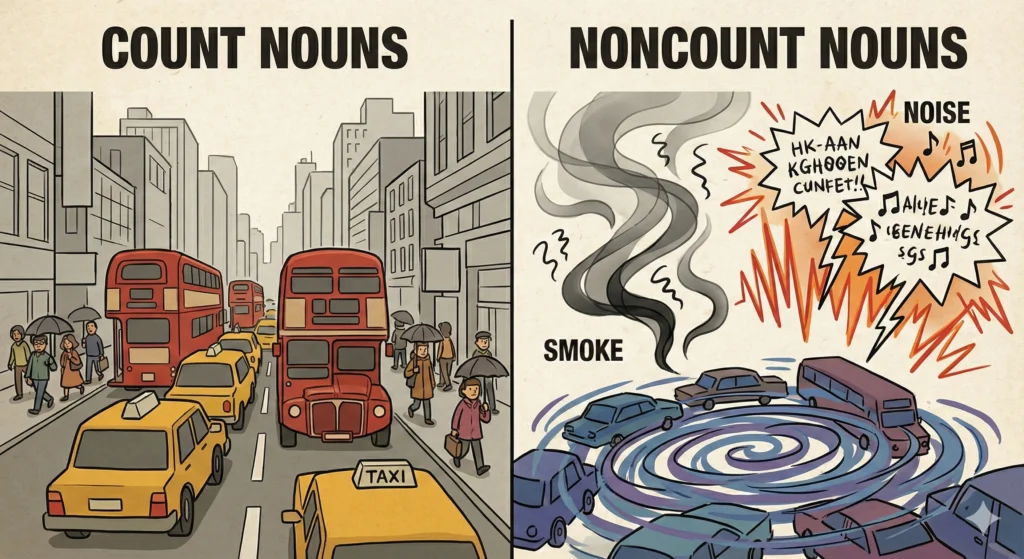
The rule depends on whether the noun is Count (items you can count: 1 car, 2 cars) or Noncount (abstract or bulk items: pollution, water, traffic).
| Expression Type | With Count Nouns (Plural) | With Noncount Nouns (Singular) |
|---|---|---|
| Excess (Negative) | too many cars | too much pollution |
| Reduction (Comparative) | fewer cars | less pollution |
| Increase (Comparative) | more streetlights | more public transportation |
| Insufficiency | not enough police officers | not enough parking |
📝 Notes
Common Mistake: Native speakers often say “less items” in informal speech, but strictly speaking, you must use fewer with plural count nouns (e.g., fewer items, not less items).
Shared Words: Notice that more and enough are used for both categories. You don’t need to change these words based on the noun type.
Verb Agreement: Count nouns usually take a plural verb (There are too many cars), while noncount nouns take a singular verb (There is too much pollution).
💬 Examples
Count
- There are too many people in this room; we need fewer chairs to make space.
Noncount
- I drank too much coffee today, so now I have less energy than usual.
Both
- We need more time (noncount) and more volunteers (count) to finish the project.
This quiz is for logged in users only.
